Five Elements vs Five Energies — Same Roots, Modern Language
Wu Xing / Five Elements meet Five Energies: one tradition, a clearer self-reflection vocabulary.
You read Five Elements in one article and Five Energies in the next.
Are they the same thing?
Are they competing brands?
Did someone just rename an ancient system to sound modern?
Fair questions. The confusion is common — and it can make the whole map feel like marketing instead of language.
Start with what you already feel
Before the terms arrive, notice your own week:
Some days you move outward — starting, warming, pushing forward.
Some days you move inward — feeling first, needing space, reading the room quietly.
Some days you hold steady. Some days you refine. Some days you grow toward what's next.
None of those days cancels the others.
Both can be you. They are different rhythms.
The ancient system gave names to those rhythms.
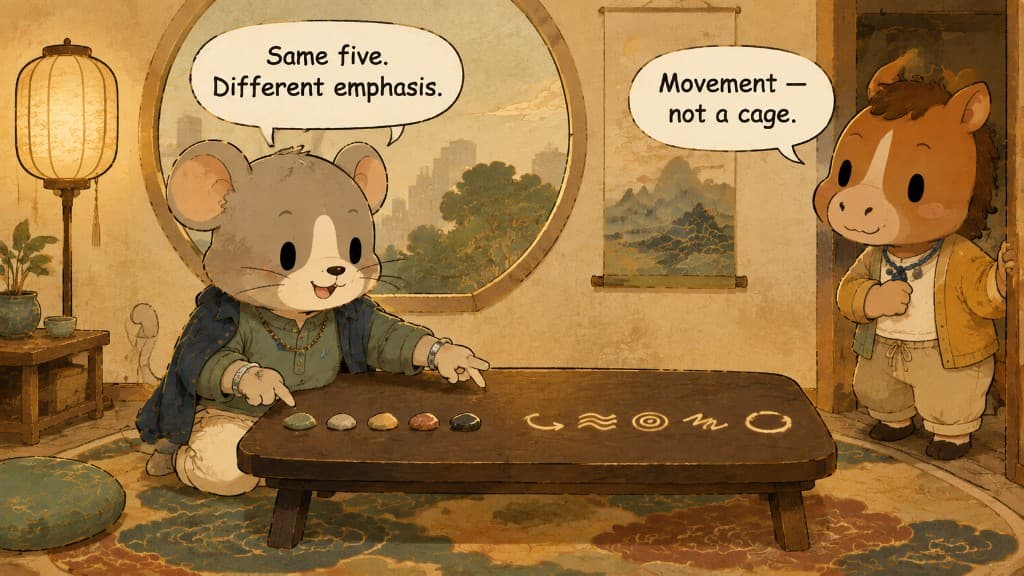
We use one modern vocabulary so the names feel like mirrors — not cages.
Five Elements — the tradition
In Chinese philosophy, Wu Xing (五行) is often translated as Five Elements: Wood, Fire, Earth, Metal, and Water.
For centuries, this framework described cycles in nature, health, timing, and human temperament. Elements support each other. Elements check or restrain each other. Nothing lives alone.
That is not fortune-telling slang.
It is a way of naming relationships between patterns — in the world and in people.
We respect that root. We do not pretend it never existed.
Five Energies — our translation
In the Energy Guide, we say Five Energies instead of Five Elements.
Same five rhythms. Different emphasis.
Elements can sound fixed — like substances you are made of forever.
Energies sounds like movement — how you tend to show up, recharge, and meet others.
We are not replacing the tradition.
We are translating it for self-reflection: Fire, Water, Earth, Metal, Wood as lived patterns, not personality boxes.
This system does not tell you who you are.
It helps you notice how you move.
Why the distinction matters
If you only hear "elements," you might hunt a permanent label.
If you hear "energies," you might stay curious about which rhythm leads this season of your life.
That shift matters in love, work, and friendship — anywhere two rhythms meet and friction gets misread as doom.
Neither name is automatically better.
The useful question is whether the language helps you name a pattern without turning it into a verdict.
Where to go next
Meet the five mirrors in plain language:
Meet the Five Energies
Curious how birth time enters the map?
What Is BaZi? A Chinese Birth Chart as a Reflection Tool
Or skip ahead and notice your leading rhythm:
Soft-check your Hidden Energy Type
Continue reading
 Start Here
Meet the Five Energies — Fire, Water, Earth, Metal, Wood
Five Energies aren’t personality boxes. They’re a language for rhythms you already feel — Fire, Water, Earth, Metal, Wood — and you’re usually a mix.
What Is BaZi? A Chinese Birth Chart as a Reflection Tool
BaZi isn't a fate sentence — it's an Energy Map language for patterns you can explore.
 Start Here
You Are Not Broken — You Might Be in a Different Season
Feeling stuck doesn’t mean you’re broken. You might simply be in a different season — a kinder rhythm frame for modern self-awareness.